
In November, I spoke at a Knowledge E webinar on generating research impact, drawing on the training programme Research Consulting developed with them. Here I expand on that talk, discussing why impact so rarely follows the route we plan for and what institutions can do about it.
Research impact is one of those terms we all use but don’t stop to define. Ask people in a university what it means, and you will often hear about well-cited papers, successful grants and press coverage. These are real achievements, and they often pave the way for impact. But they are not quite the same thing.
I think the sector’s difficulty with impact has little to do with commitment. When Sage surveyed more than 1,800 social and behavioural scientists in 2025, 92% agreed that the ultimate goal of research is to benefit society. The difficulty comes from the default picture in our heads: a straight road that runs from research question to publication to use, with impact waiting at the end like a finish line.
In reality, however, most research impact travels routes far messier than plans and templates assume.
Outputs are not impact
Research England defines impact as “an effect on, change or benefit to the economy, society, culture, public policy or services, health, the environment or quality of life, beyond academia”. Publishing a paper is not “an effect”, and neither is finishing a project. Impact is what happens next, outside the university.
The definition is also deliberately broad, because real change rarely stays in one box. Its list of areas, from public policy and health to culture and the environment, doubles as a handy checklist of where to look for impact.
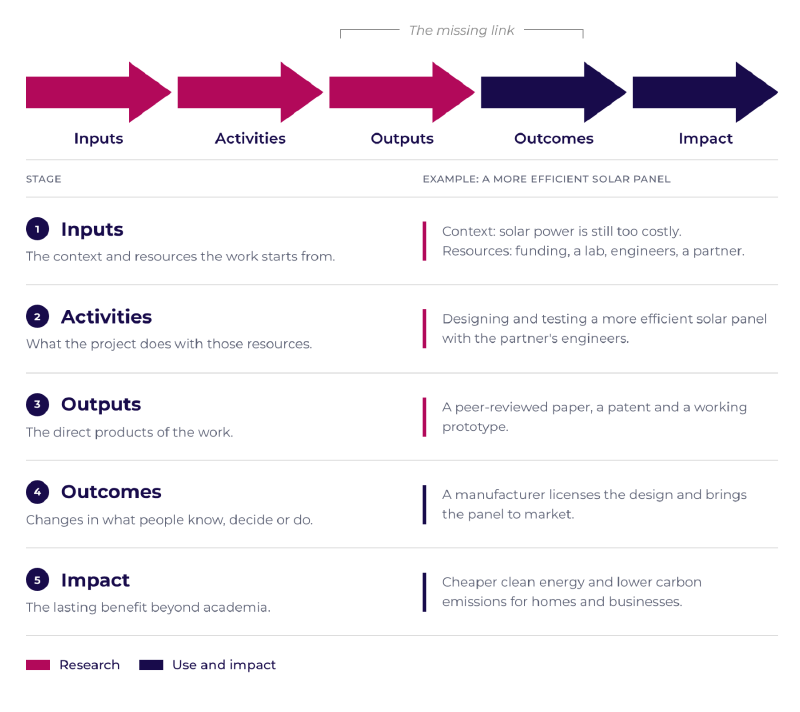
The difference between outputs and impact might sound obvious, yet a great deal of what gets reported as impact is really an output. A theory of change (Figure 1) makes the difference visible: it sets out the chain from inputs and activities to outputs, then to outcomes, and only then to impact. We often use theories of change in our client work for this reason: they map the “missing link” between what a project does and what it seeks to achieve.
Getting this distinction right matters for assessment too. In the UK, the Research Excellence Framework gives engagement and impact 25% of the weighting in REF 2029 (my colleague Angharad Roberts has unpacked the new guidance here).
The straight road is the exception
The linear route from research delivery to impact does exist. Say an engineer designs a more efficient solar panel and manufacturers adopt it (see Figure 1 above). The path from research to use can be short and visible. At the same time, even a seemingly straightforward route takes engagement and relationships: linear describes the direction, not the effort.
Broadly speaking, most impact takes other routes. When RAND Europe analysed the impact case studies submitted to REF 2021, it found 48,571 pathways to impact, of which 5,397 were unique. In our experience, six macro categories of impact are especially common:
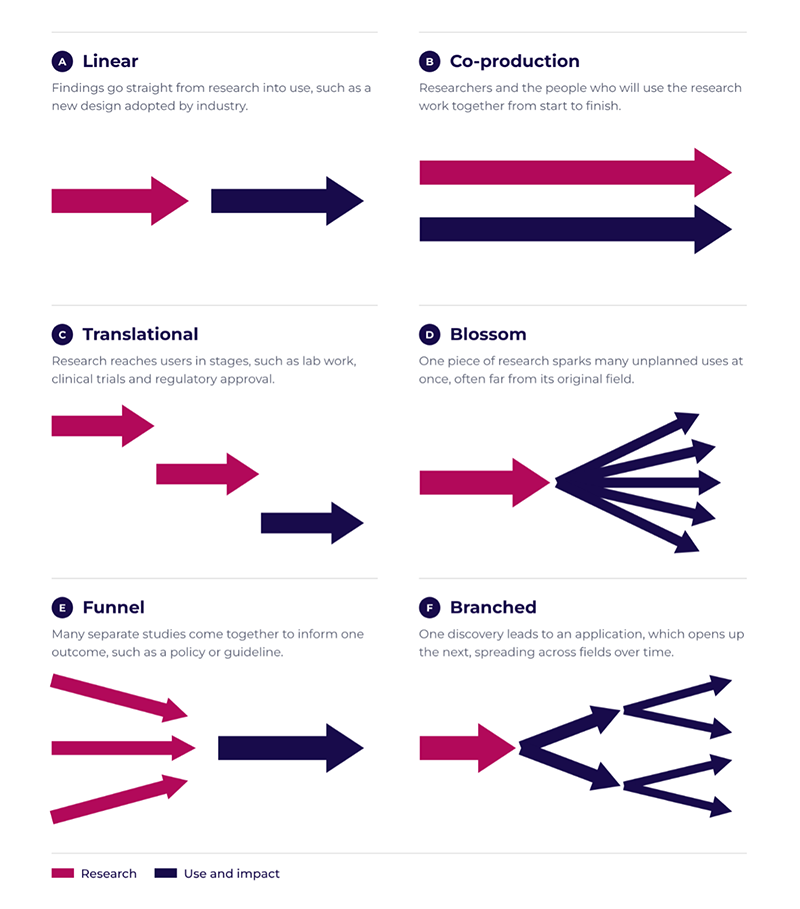
In medicine, the route is often translational, moving in stages from laboratory to clinical trials to regulatory approval before research reaches patients. For complex social problems, impact tends to be co-produced, with the people who will use the research shaping it from the first question onwards. Sometimes many strands of evidence funnel into one outcome, as when the Intergovernmental Panel on Climate Change turns the work of thousands of scientists into assessments that policymakers can act on. And sometimes one discovery keeps branching: CRISPR began as research into how bacteria fight viruses and now underpins gene therapies and more resilient crops.
My favourite route is the least predictable. Research can blossom, seeding applications far beyond its original purpose. Tim Berners-Lee proposed the World Wide Web at CERN so that scientists could share information. CERN then placed the technology in the public domain, and it took root in places nobody had planned for. No impact strategy would have forecast that.
For institutions, the pathways change what good support from professional services looks like. Translation needs patient funding, co-production needs partners at the bid stage, and blossoming needs research and data that are openly available. An institution that supports only the straight road is backing the exception and neglecting most of what its research achieves.
Keep the evidence as you go
If impact unfolds over years, along routes nobody predicted, it cannot be reconstructed in the months before an assessment deadline. Yet that is often when the search begins, and the scramble usually lands on professional services. The answer is to build evidence collection into how projects are supported from the outset, and to keep asking three questions:
- What has changed?
- Who has benefited?
- How have they benefited?
Publications and citations will not answer these questions. Testimony from users, policy documents that cite the work and data from partner organisations will, and all of these are far easier to collect as they happen than years later.
We cannot pretend this is easy. Few researchers are trained to collect this kind of evidence, and promotion criteria still reward publications above almost everything else. For example, in the Sage survey, only 37% of respondents said their institution rewards applying research outside academia through tenure or promotion. At this year’s OASPA conference, a session on what counts in research assessment reached the conclusion that publishers, funders and institutions each hold part of the answer, and nothing shifts unless they act together.
Until incentives change, impact will stay at the edges of most people’s jobs. But waiting for perfect conditions is a mistake. Institutions should start with what they can realistically control: help researchers build the networks through which unexpected uses emerge, capture stories as they surface, and treat impact as joint work between researchers, leadership and professional services.
This is the thinking behind the Generating Research Impact programme we developed with Knowledge E, and behind our work with universities including Salford, Liverpool John Moores and Galway to evidence the impact of their research.
If your institution is wrestling with the same questions, whether for REF 2029 or for its own sake, get in touch.