


A change in confidence at Frankfurt: publishers look ahead with cautious optimism
For the second year in a row, we ran our Publishing Pulse Check at the Frankfurt Book Fair. The survey asks people how market conditions compare with a year ago, how they feel about the next 12 months, what their biggest challenges are, and where their organisation is investing.
This year, we received 22 responses: 8 from publishers (commercial, society and independent) and 14 from technology vendors, service providers, consultancies and aggregators. Like last year, these findings are best interpreted as a snapshot of sentiment across the scholarly publishing ecosystem rather than a representative picture of the sector.
Perhaps one of the most striking findings is a possible reversal of last year’s confidence gap. In 2025 publishers were the gloomiest of all respondents, however, among this year’s respondents they are now the more optimistic group. Not one publisher told us conditions had got worse over the last year. This survey offers only an early indication of whether confidence is genuinely recovering, but informal conversations with publishers at the fair also suggested a more positive mood.
Publishers have steadied, and the pessimism has moved elsewhere
At Frankfurt last year, 62% of publishers said conditions were worse than 12 months earlier and only 23% were optimistic about the next 12 months. This year 7 of 8 publishers said conditions were about the same and one said they were better. None said they were worse. Five of 8 (63%) were optimistic about the year ahead and the other three were neutral.
Non-publishers however have moved in the other direction. Last year 63% of them were optimistic while this year 6 of 14 (43%) are optimistic and 3 of 14 are pessimistic. All three respondents who said conditions had got worse work in consulting or advisory roles. However, whether this reflects a different perspective on the market or pressures facing consultancies themselves, is difficult to say.
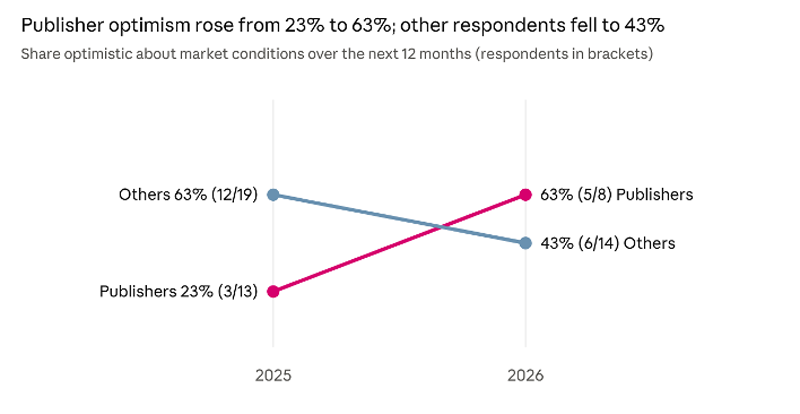
Across everyone, 15 of 22 (68%) described conditions as about the same as last year, which we read more as stabilisation of conditions than a recovery.
AI is still a major challenge facing the sector
The pace of AI and technology change was the most cited challenge in the survey, chosen by 14 of 22 respondents (64%). It topped the list for both publishers (6 of 8) and non-publishers (8 of 14) alike.
Geopolitical uncertainty, which led publishers’ concerns last year at 69%, was picked by 3 of 8 this year. Last year’s survey took place amid proposals for deep cuts to US federal research funding. Congress has since rejected most of them, and the largest publishers, including Springer Nature and Elsevier, have reported steady growth in 2026. The US risk has not disappeared, though. A proposed federal rule published in May would stop most publication charges being paid from federal grants. Congress has paused it through a temporary funding bill, but only until 11 December. Even so, only one respondent (and no publishers) chose policy and regulatory change as a challenge this year.
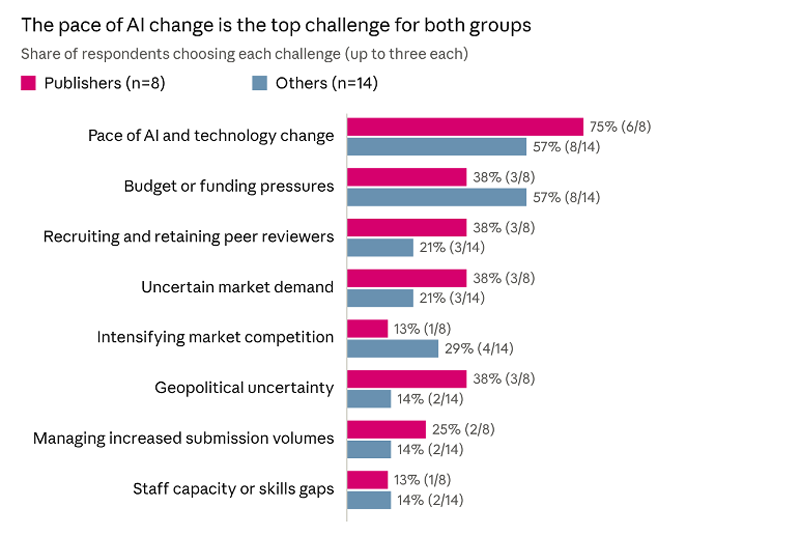
As in 2025, research integrity did not feature as a headline challenge, with only 2 of 22 respondents choosing it. That isn’t to say people are indifferent to it. Five of 22 are investing in research integrity infrastructure, and three named trust and verification as their biggest opportunity. Integrity may now be seen less as a risk to manage and more as something to build value around, particularly in the era of generative AI.
Peer review, integrity’s first line of defence, is under more visible strain: recruiting and retaining peer reviewers was a concern for 3 of 8 publishers. With publishers reporting strong growth in submissions, the question is who is going to review them all?
Investment: partnerships and AI lead, open access drops off the list
AI and automation and partnership development tied as the top investment priorities, each chosen by 10 of 22 respondents (45%). Publishers put partnerships first (4 of 8), followed by AI and author services (3 of 8 each). Non-publishers led with AI (7 of 14), followed by partnership development and systems and workflow efficiency (6 of 14 each).
Read together, this could point to a division of labour. Vendors and service providers are building AI tools, while many publishers would rather partner for those capabilities than develop their own. That seems to be a sensible choice given how fast the technology is moving and how costly it is to build. And it changes the strategic question for publishers from what to build to who to work with.
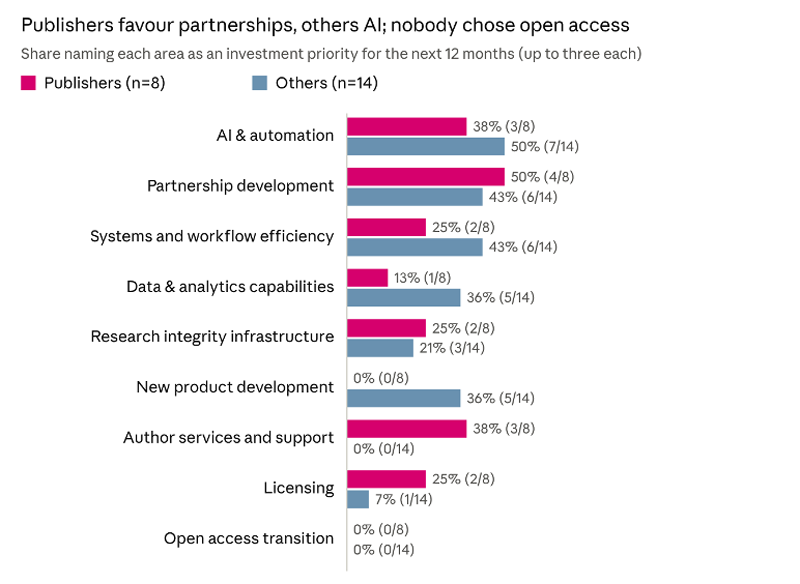
Interestingly, no respondent chose open access transition as an investment priority, down from 9% last year. That fits a wider pattern we’re seeing. Open access has accounted for around half of all articles since 2022, and output from OASPA members, which grew 16% in 2022, grew just 1% in 2024. Our sense, from conversations across the sector, is that open access still matters but is no longer the main event. With AI, research integrity and policy all shifting at once, open access has become one priority among many, or simply business as usual.
Trust and licensing are also opportunities
We also asked an optional, free-text question: what is the biggest opportunity in academic publishing in 2026? Ten of our 22 respondents answered, and two themes came through.
The first was trust and verification. One publisher wrote: “Audiences increasingly see trust and verification as critical – this is our jam!” A multi-role vendor saw the chance to “be the trusted providers of content in a world of misinformation”, and an aggregator pointed to “building shared infrastructure for trust markers”.
The second was licensing, raised by two publishers and a vendor, one of whom specified AI licensing in particular.
The two may be connected. As more information reaches readers through AI tools, verified and trustworthy content is becoming more and more valuable and is an important part of what makes scholarly publishing worth licensing.
While no respondents prioritised investing in open access, two commercial publishers still said that they saw opportunity in open access. Others mentioned responsible AI, better tools to demonstrate real-world impact, and the governance and skills needed around new submission-handling tools: “lots of opportunity for highly skilled workers in this space.”
Conclusion
Last year we described an industry at an inflection point, with publishers cautious and vendors confident. A year on, publishers sound more optimistic. While not necessarily celebrating, no publisher we heard from thinks things have got worse, and most are optimistic about the year ahead.
What has changed however, is the shape of the worry. Geopolitics has eased as a headline concern, and the pace of AI and technology change is the dominant challenge facing publishers and suppliers. And the response looks increasingly collaborative: partnership development is a top investment priority for both groups, and trust, verification and licensing are where people see the opportunity.
We hope to run the Publishing Pulse Check again at Frankfurt 2027 to see whether publishers’ new-found steadiness holds. In the meantime, if you’d like to talk about what these findings mean for your organisation, get in touch.
About the survey: Findings are based on the 22 responses. Respondents could choose up to three challenges and up to three investment priorities, so percentages are shares of respondents and do not sum to 100. 2025 figures are from our 2025 Frankfurt Publishing Pulse Check (32 responses).


